EssaysFrom the Friend of Frank archive
Plastic Explosives and Almond Croissants
A haircut, a coffee, a good almond croissant, and the stranger at the only free table.
TRAVEL & PLACE
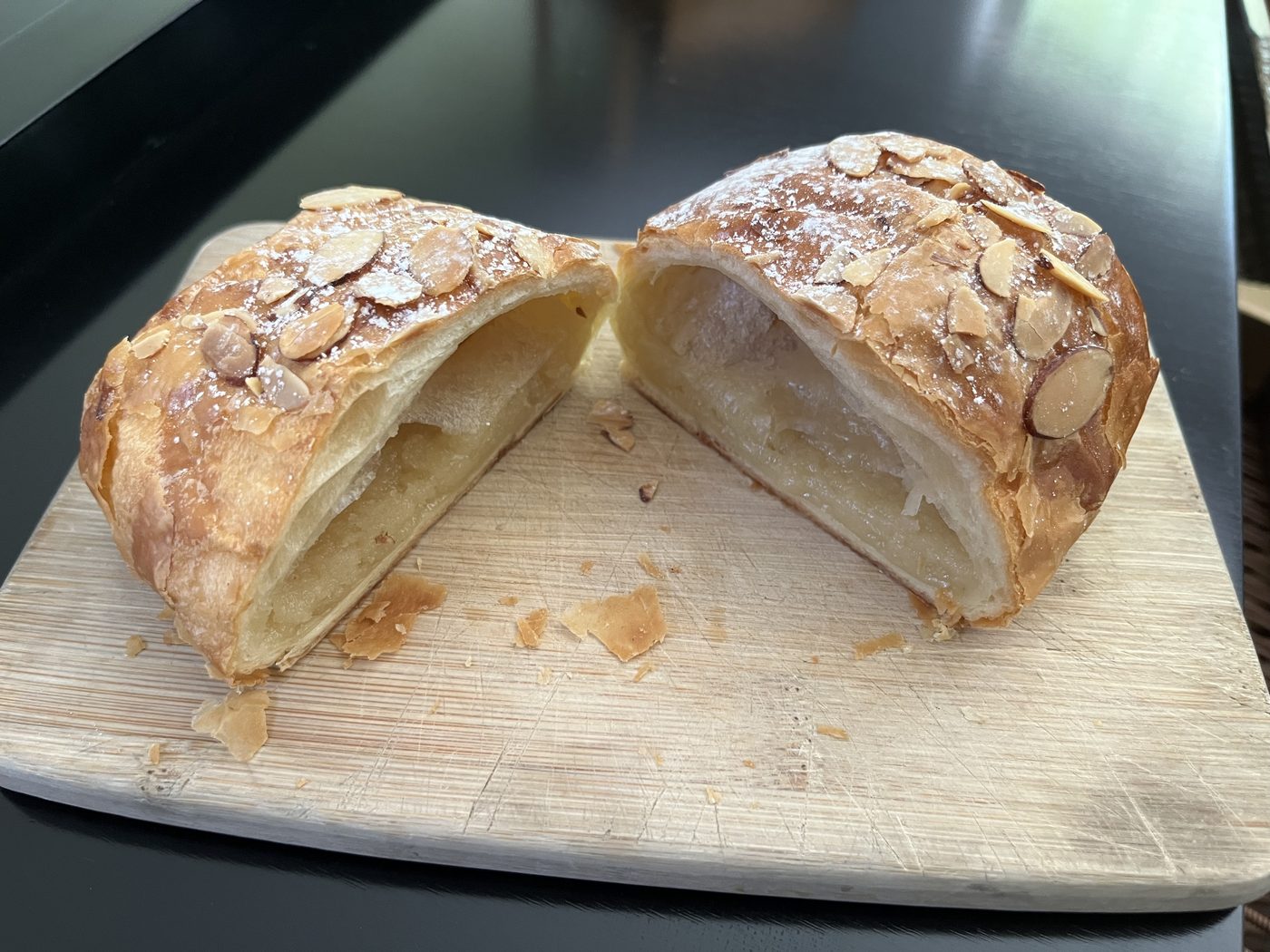
I went for a haircut yesterday morning and afterward decided to treat myself to a cup of coffee and an almond croissant. My neighborhood bakery, Breads Unlimited, sits next to my barber shop, so it was an easy choice. Besides, "Breads" makes a more-than-acceptable almond croissant.
The almond croissant from Breads Unlimited. Recommended.
I took my purchase outside intending to sit at the table but it was occupied by an older couple. There was a bench adjacent so I sat there instead.
The woman was talking. About plastic explosives. Knowledgably.
She was explaining how such explosives gain their power when intense compression of the molecules is released. The French invented plastique, she explained, as the man listened with quiet interest. She spoke in a normal tone but lucidly and with animation. She clearly knew a lot about her subject and was eager to share.
She looked to be in her 60s. She had short bleach-blond hair and wore nondescript pastels. I noted blue Crocs on her feet. The man, who may have been in his 70s, was white-haired and on the lanky side. Both appeared to be Caucasian. He said next to nothing during the encounter but listened with evident interest.
I wasn't trying to eavesdrop but I couldn't help myself. I was only 3 feet away.
Imagine me sitting on the bench, next to the brown dog. I'm 3 feet from the conversation.
In due course the encounter ended. The woman stood, the man stood. He thanked her for an interesting chat, she smiled and said it was nice talking to a stranger. He walked left, she walked right.
Well.
Until they went off in separate directions, I assumed they were married. Wouldn't you?
How did she know so much about plastique? Why was she talking about it with a stranger? How did this conversation start? Who was this woman?
Pause for context.
This conversation took place at 9:30 of a pea-soupy late-summer day outside the Bradley Center, a perfectly ordinary strip mall in downtown Bethesda MD.
The Bradley Center
But this is the Washington DC area. We're seven miles from the White House.
Maybe she was a retired spy.
She'd be perfect. No one would ever suspect such an everyday-looking woman.
Maybe she was an academic. Plenty of universities around here, plenty of think tanks.
Maybe she worked on The Hill, DC shortrhand for Congress. Maybe she worked in the White House. Or the military. Maybe she is or was a "fed," more DC shortrhand for civilian federal employees.
Maybe she was a Beltway Bandit, what we call the army of individuals who do something the federal government needs or wants. As a one-time journalist/publisher/consultant, I fit the description and made a good living at it. These are often great jobs, though there's no market for them anywhere but here.
Hell, maybe she just knew a lot about plastique and liked talking to strangers.
The woman got into a midnight blue Honda Accord, fiddled a few minutes the way people do nowadays, backed out and drove off, leaving me with my unanswered questions ... and wishing this sort of thing happened more often.
Frank S Joseph Author
P.S. It's 1965, summer in Chicago, and it's hot. Pinkie, an 11-year-old child of the mean streets, is on a quest for the White woman who gave her birth ... as a great city goes up in flames. To Do Justice, Book #3 of my "Chicago Trilogy," tells the story with humor and heart. Publication from TouchPoint Press is now set for next spring. Here's what one advance reader said:
"To Do Justice drops you into the white-hot center of the 1960s Chicago riots and gives you a street-level view of what happened and why. The big names are here -- Martin Luther King, Jesse Jackson, Richard Daley, to name a few. But the beating heart of this dramatic story is that of an orphaned biracial girl forced into the streets by an abusive foster parent ... and the hard-working AP reporter who befriends her and helps solve the mystery of her peculiar parentage. Beautifully written and eerily in-tune with the racial concerns of our own time, To Do Justice is a must-read for anyone interested in one of the most turbulent moments in American history and how it still reverberates in our collective consciousness." -Richard Armstrong, author, "The Next Hurrah" & "The Don Con"
P.P.S. Copies are still available of Trilogy Book #1, To Love Mercy. This is the 2006 edition from Mid Atlantic Highlands, but it's virtually unchanged from the edition to be republished by TouchPoint Press sometime in 2023. Copies are FREE while supplies last. If you enjoy it, all I ask is that you post a review. Contact me with a mailing address at frank@frankjoseph.com.