EssaysFrom the Friend of Frank archive
I ask a chatbot to write a novel.
I handed an AI a one-paragraph synopsis and asked for 80,000 words. What came back was not a novel.
AI & TECHNOLOGYTHE WRITING LIFE
I asked a chatbot to write a novel for me.
I registered at a website called ChatAI.com and typed, "Please write a novel using the following synopsis:"
An ordinary woman encounters the President and says something casually that touches his soul. He asks her to come back again. She in effect becomes his psychiatrist. We see why he needs one, why she needs this relationship herself for her own struggles, how word gets out, how his political opponents twist it, how it turns sour for both, possibly destroys both, but changes both in both good ways and bad.
Here's some of what came back:
Once upon a time there lived an ordinary woman named Abigail. She lived a simple life and dreamed of one day making a difference in the world. One day, her life changed when she encountered the President of the United States. During their brief conversation, she said something that touched his soul. He was so moved by her words that he asked her to come back and see him again. Abigail was taken aback by the President's request, but she decided to take a leap of faith and see what would transpire from the meeting. The President soon began to rely on Abigail as his confidant and psychiatrist. He opened up to her about his struggles, his worries, and his fears. Abigail was able to provide the President with an outlet to express himself and feel heard. Unfortunately, their relationship was soon revealed to the public. ...
Not much different from my synopsis and, at 258 words, not a novel. Hmm.
I tried again, this time asking for a novel totaling 80,000 words. ChatAI responded with a mere 193 words, starting: Once upon a time there lived an ordinary woman named Laura ...
Double hmm.
Third try, same request. Response: Once upon a time there lived an ordinary woman named Anna ... At least this time I got 243 words. Progress, huh?
Chatbots have been all over the news lately. Unless you've been living under a rock, you're alert to their potential to either a) magically enhance our lives, or b) destroy civilization as we know it.
Creative types like me -- writers, artists, etc. -- have been especially fretful. Up to now we've been smugly secure in the knowledge that no non-human could possibly create something that passes for art.
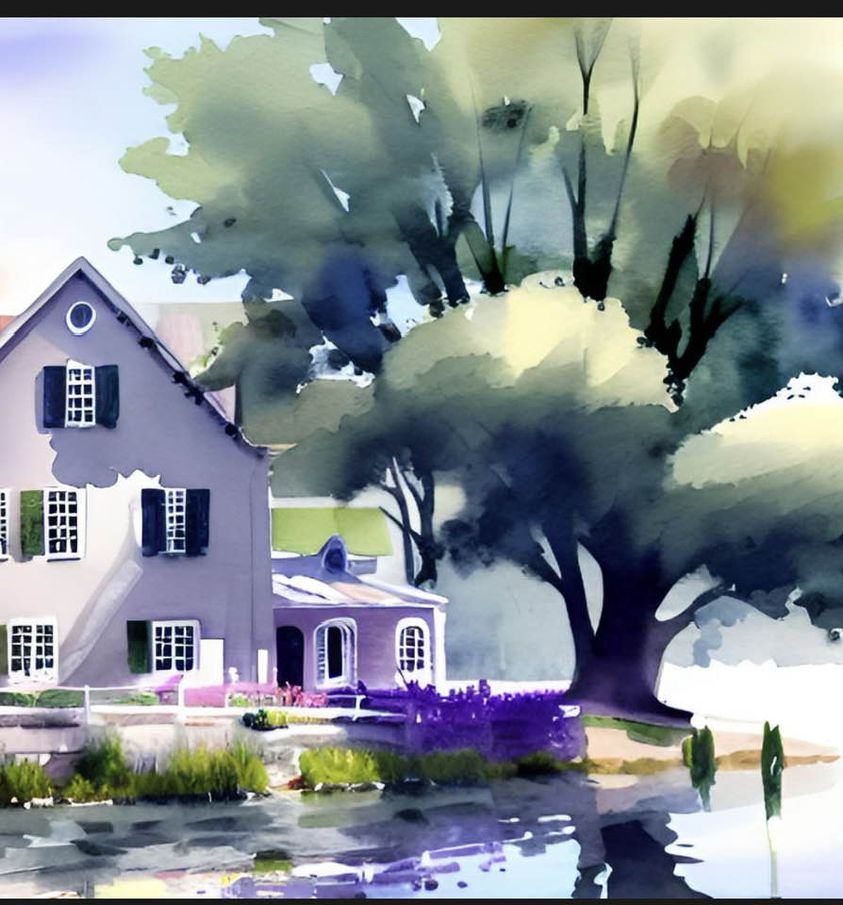
Now we know better. Look at this "painting" my daughter Shawn cooked up while playing around with a chatbot. Could you tell it was not done by a human? I couldn't.
O brave new world.
What have we learned here?
l. That the website my daughter tried could "paint" a painting; but
2. The website I tried could not "write" a novel*. All it could do was parrot back my synopsis, tweaking the words -- but each time starting out with the same clichéd "Once upon a time there lived" etc. At least it changed the woman's name. Hello Abigail, hello Laura, hello Anna.
* So far. I am not at all comforted that the damn thing won't be spewing out John Grisham-worthy page-turners tomorrow or the day after.
Some say otherwise. Artificial intelligence (AI) and its offspring the chatbot will become a tool, a slave, a creative donkey to bear the burden of writing first drafts or whatever, and we will enter a golden age where creativity flowers, these worthies assert.
I say they're whistling in the dark. Nobody knows where this is going.
Take my Web browser. Bing just acquired the capability to "talk" to me in language that seems quite "human." I know its secret: It casts a web across the Web for word sequences, then mindlessly strings them together into "language". But hey, it fools me.
What advice do I have, Dear Reader? Well, you could a) embrace it, b) disregard it, or c) hide under that rock of yours. It wouldn't make much difference. This thing is moving fast.
There is one thing I can say with certainty though: it's big. It matters. It will change our lives somehow. Take a deep breath.
Frank S Joseph Author
P.S. Advance praise for my award-winning novel To Do Justice ... from a Pulitzer Prize columnist! Leonard Pitts Jr., author of the gripping Chicago novel Grant Park, said this:
“A fast-moving tale of race, corruption and self-discovery set against the unrest -- and the hope -- of Chicago during Martin Luther King’s fateful 1965-66 fair housing campaign.”
To Do Justice is pending publication from Touchpoint Press. I'd like to invite you, Dear Reader, to take an advance look and post your own review. Email me at frank@frankjoseph.com and I'll shoot you an e-copy. If you'd prefer a physical book, I'll see what can be arranged.